

Moving from Property Ownership to Active Real Estate Portfolio Management
Table of Contents
- Introduction
- What is Real Estate Portfolio Management?
-
The Mindset Shift: From Property Owner to Portfolio Manager
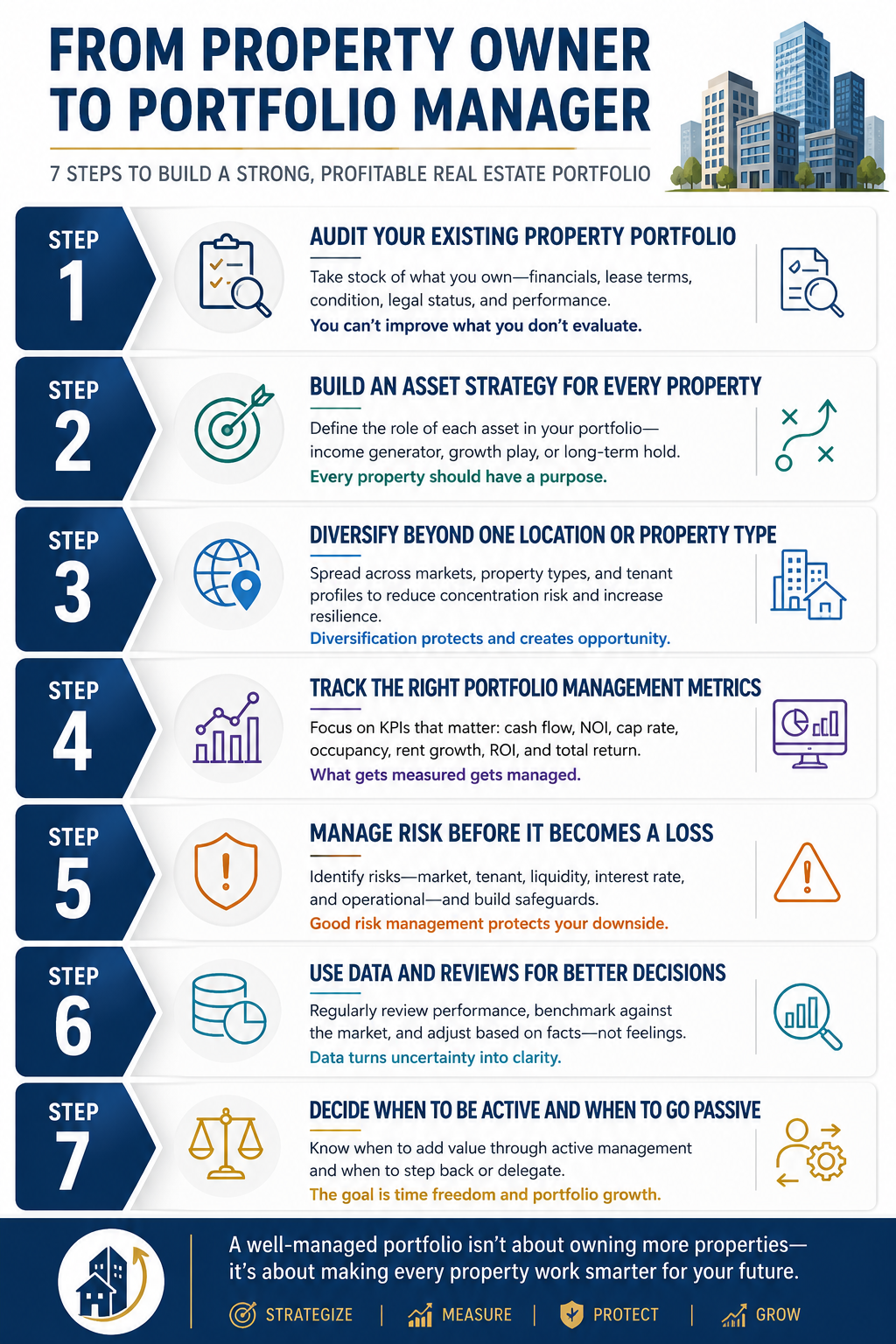
- Step 1: Audit Your Existing Property Portfolio
- Step 2: Build an Asset Strategy for Every Property
- Step 3: Diversify Beyond One Location or Property Type
- Step 4: Track the Right Portfolio Management Metrics
- Step 5: Manage Risk Before It Becomes a Loss
- Step 6: Use Data and Reviews for Better Decisions
- Step 7: Decide When to Be Active and When to Go Passive
- Why Indian Families and NRIs Need Real Estate Portfolio Management?
- How Indiassetz Helps Property Owners Move from Ownership to Portfolio Management?
- Conclusion: Treat Every Property Like a Performing Asset
- FAQs on Real Estate Portfolio Management
Introduction
You may own property, but is every property truly working for you?
For many Indian families, property ownership has traditionally meant buying an apartment, inheriting land, renting out a home, or holding a commercial asset for long-term appreciation. But as real estate becomes a larger, more complex, and more valuable asset class, ownership alone is no longer enough. The real question is: How well is your real estate portfolio being managed?
According to India Brand Equity Foundation, India’s real estate sector is expected to reach US$ 1 trillion by 2030, up from US$ 200 billion in 2021, and contribute nearly 13% to India’s GDP by 2025, according to IBEF. The sector is also projected to expand to US$ 5.8 trillion by 2047, contributing 15.5% to GDP.
This growth makes one thing clear: real estate is no longer just a passive family asset. It is a serious wealth category that needs structured Portfolio Management and a clear Asset Strategy.

What is Real Estate Portfolio Management?
Real Estate Portfolio Management is the process of tracking, evaluating, improving, and strategically managing multiple property assets to generate better returns, reduce risks, and support long-term wealth goals.
Basic property ownership is usually limited to holding an asset, collecting rent, paying maintenance, or waiting for appreciation. Portfolio Management, on the other hand, asks deeper questions:
Is the property generating enough rental yield?
Is the location still growing?
Is the asset legally clear and well documented?
Is the maintenance cost reducing profitability?
Should the property be held, rented, improved, refinanced, sold, or reinvested?
This is where Asset Strategy becomes important. Every property in a portfolio must have a clear role. One asset may be held for rental income, another for capital appreciation, another for future redevelopment, and another for liquidity or family succession.
Without an asset strategy, even valuable properties can become underperforming assets.
The Mindset Shift: From Property Owner to Portfolio Manager
The shift from property ownership to real estate portfolio management begins with a simple change in mindset.
A property owner asks:“What is my property worth?”
A portfolio manager asks:“What role does this property play in my wealth plan?”
This difference is important. Real estate wealth is not created only by buying property. It is created by reviewing performance, managing risk, improving the asset, choosing the right tenants, maintaining documentation, and making timely decisions.
Professional investors already follow this approach. Institutional investments in Indian real estate reached an all-time high of US$ 8.47 billion in 2025, up 29% year-on-year from US$ 6.56 billion in 2024, according to Economic Times.
Institutional investors do not buy property emotionally. They evaluate real estate through returns, cash flow, risk, tenant quality, capital appreciation, and exit potential. Individual property owners can benefit from the same structured thinking.
Step 1: Audit Your Existing Property Portfolio
The first step in Property Portfolio Management is a complete audit. Many property owners have assets across cities, inherited homes, vacant land, rental apartments, or commercial units, but the details are often scattered.
A proper audit should include:
Property ownership documents
Khata or municipal records
Property tax receipts
Rental agreements
Loan details
Insurance documents
Maintenance records
Tenant information
Utility bills
Current market value
Legal or encumbrance status
This helps owners understand what they own, what is earning, what is idle, and what may create risk in the future.
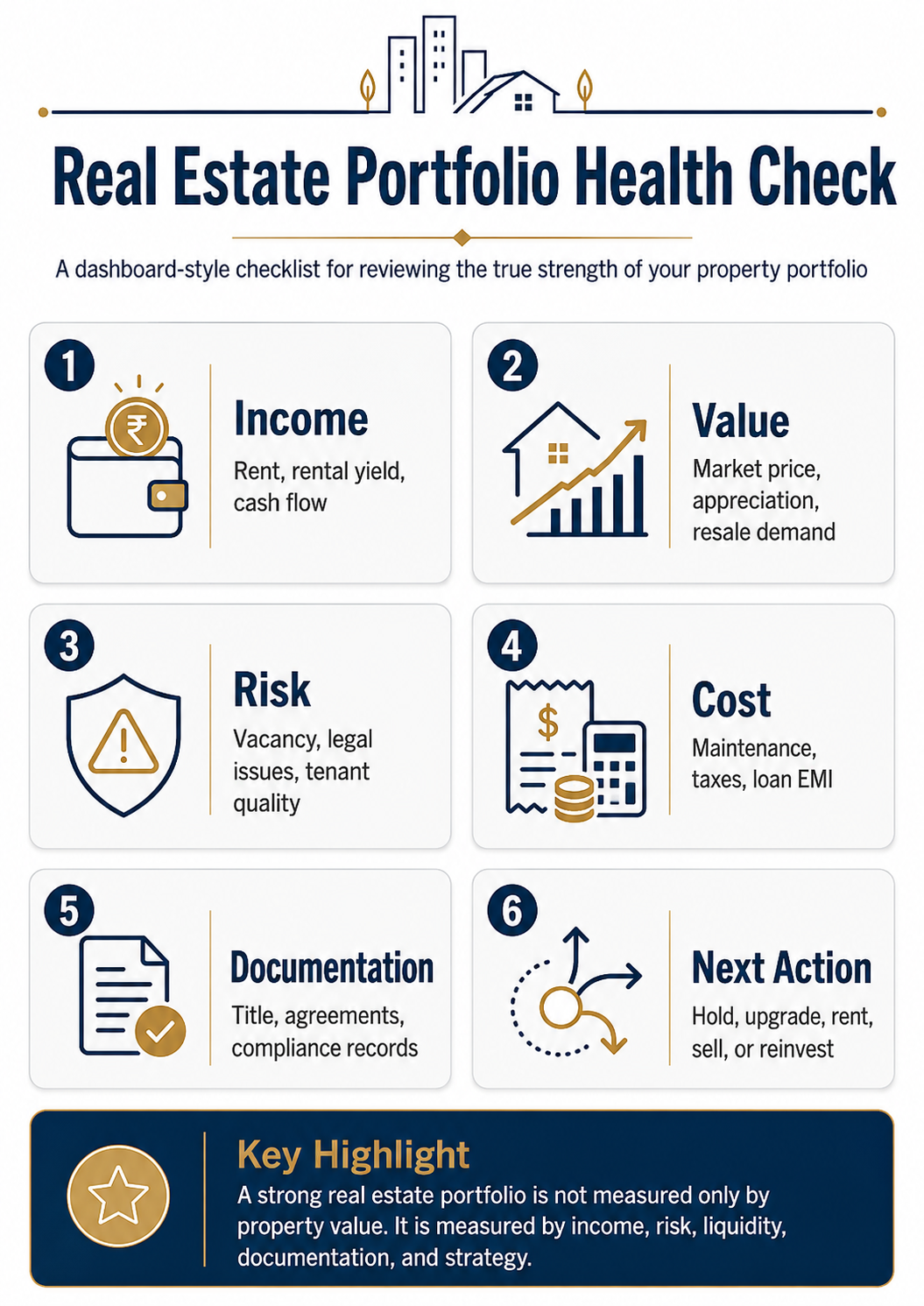
Once the documents are organised, the next step is asset performance evaluation. A property should be reviewed based on rental yield, monthly cash flow, occupancy, appreciation potential, maintenance cost, resale demand, and location outlook.
For example, a property may look valuable on paper but may still be underperforming if it has low rental income, repeated vacancy, high repair costs, or weak resale demand.
Step 2: Build an Asset Strategy for Every Property
Every property should have an Asset Strategy. This means deciding the best action for that asset based on its current performance and future potential.
The five common asset strategy decisions are:
Hold: Continue owning the property if it offers stable income, appreciation potential, or strategic family value.
Improve: Renovate, repair, furnish, or reposition the asset to improve rent, resale value, or tenant appeal.
Rent: Convert an idle or vacant property into an income-generating asset.
Refinance: Use the property’s value or cash flow to restructure debt or unlock capital.
Sell: Exit the asset if it is underperforming, legally complicated, costly to maintain, or no longer aligned with wealth goals.
Many Indian families hold property emotionally. This is understandable, especially when the property is inherited or has sentimental value. But emotional ownership can lead to poor financial outcomes if the asset is vacant, disputed, deteriorating, or delivering low returns.
A strong asset strategy brings discipline. It helps property owners make decisions based on value, income, risk, and future use.
Step 3: Diversify Beyond One Location or Property Type
A healthy real estate investment portfolio should not depend too much on one location, one tenant, one property type, or one market cycle.
Diversification can happen across:
Residential apartments
Commercial offices
Retail spaces
Land parcels
Warehouses
Rental income assets
Redevelopment opportunities
Different cities or micro-markets
For example, a family may own three apartments in the same locality. While this may feel safe, it also creates concentration risk. If rental demand slows in that locality, infrastructure development is delayed, or resale prices stagnate, the entire portfolio may be affected.
Market demand is also changing. Business Standard reported that homes priced above
₹1 crore accounted for half of India’s residential sales in 2025, while affordable housing sales declined 17% year-on-year.
This shift shows why property owners must regularly review whether their assets are positioned for the right buyer, tenant, or exit opportunity. A property that performed well ten years ago may not automatically remain the best-performing asset today.
Step 4: Track the Right Portfolio Management Metrics
Real estate portfolio management becomes effective only when owners track the right metrics. Property value alone is not enough.
A property may have high market value but low rent. Another may have modest appreciation but strong monthly cash flow. A third may have good location potential but unclear documentation. Each of these requires a different strategy.
Key Portfolio Management Metrics
| Metric | Why It Matters |
|---|---|
| Rental Yield | Shows how efficiently the property generates income |
| Monthly Cash Flow | Measures rent after expenses, EMI, tax, and maintenance |
| Occupancy Rate | Shows how consistently the property remains rented |
| Tenant Quality | Reduces payment delays, disputes, and vacancy risk |
| Maintenance Cost | Reveals hidden leakage in returns |
| Market Value | Shows current asset worth and appreciation |
| Capital Appreciation | Measures long-term growth potential |
| ROI | Shows total return compared to investment |
| Cap Rate | Helps compare income-generating properties |
| IRR | Useful for long-term investment performance |
| DSCR | Shows whether rental income can support debt obligations |
| Legal Clarity | Protects resale, rental, and succession value |
The aim is not to make every owner a financial analyst. The aim is to help owners make informed decisions.
If a property has low rental yield, high maintenance cost, and weak appreciation, it may need repositioning or exit planning. If another property has strong tenant demand and rising market value, it may deserve further investment.
Step 5: Manage Risk Before It Becomes a Loss
Real estate risk often builds slowly. A vacant property, unclear document, delayed maintenance issue, or weak tenant agreement may not look serious at first. But over time, these issues can reduce value, block transactions, or create legal complications.
Common risks in Indian real estate portfolios include:
Vacancy risk
Tenant default risk
Legal and title risk
Market slowdown risk
Maintenance risk
Liquidity risk
Regulatory or compliance risk
Succession disputes
Overexposure to one city or locality
Documentation is a major part of Asset Strategy. Property papers, tax records, rental agreements, encumbrance checks, mutation records, khata documents, and succession clarity directly affect the value and liquidity of an asset.
A property with poor documentation may be difficult to sell, lease, refinance, or transfer. That is why active portfolio management must include legal and compliance checks, not just rent and valuation.
Step 6: Use Data and Reviews for Better Decisions
Active real estate ownership needs regular reviews. Property owners should move away from memory-based tracking and start using structured data.
A simple property portfolio review should include:
Current market value
Rental income
Tenant status
Expense records
Maintenance history
Loan obligations
Legal document status
Locality price trends
Vacancy history
Next recommended action
India’s real estate sector is attracting strong capital interest. Economic Times reported that the sector saw US$ 30.7 billion in equity inflows between 2024 and Q1 2026, an 88% rise from US$ 16.3 billion in 2022–2023, citing 5paisa. When institutional and private capital is becoming more active, individual property owners also need better visibility into their assets. A yearly or quarterly portfolio review can help owners identify which properties are performing, which need improvement, and which may need exit planning.
Step 7: Decide When to Be Active and When to Go Passive
Not every property owner wants to be involved in daily operations. Some owners prefer direct control over leasing, maintenance, sale timing, and renovation. Others want professional support because they live in another city or country, have multiple properties, or do not want operational stress.
Active ownership is useful when the owner wants to:
Improve rental income
Upgrade the property
Negotiate leases
Monitor tenants
Prepare for sale
Reposition the asset
Handle redevelopment potential
Passive real estate investing or advisory-led ownership becomes useful when the owner wants exposure to real estate without handling daily management. This may include professionally managed properties, REITs, funds, or advisory-supported real estate portfolios.
The right choice depends on the owner’s time, risk appetite, asset size, family goals, and liquidity needs.
Why Indian Families and NRIs Need Real Estate Portfolio Management?
For Indian families and NRIs, real estate is often more than an investment. It may include inherited homes, ancestral land, vacant apartments, commercial spaces, family-use properties, and assets spread across different cities.
This makes portfolio management essential.
Economic Times reported that India’s total household assets are estimated at US$ 19.6 trillion, with US$ 11.6 trillion, or 59%, held by the top wealth bracket, according to a Bernstein report. The report also highlighted that a significant portion of wealth among affluent households remains parked in real estate and gold.
For many families, property is one of the largest components of wealth. Yet it is often the least organised. Unlike financial assets, real estate may not have a single dashboard, updated valuation, clean documentation, or clear succession plan.
This creates challenges such as:
Difficulty tracking multiple properties
Unclear ownership records
Vacant or underused assets
Low rental yield
Delayed maintenance
Disputes among family members
Tax and compliance gaps
Lack of exit planning
Poor visibility for NRIs
Real Estate Wealth Management helps families bring structure to these assets. It supports better decisions around holding, renting, selling, transferring, or reinvesting.
How Indiassetz Helps Property Owners Move from Ownership to Portfolio Management?
Indiassetz helps property owners move from scattered ownership to structured real estate portfolio management through a complete support ecosystem across buying, selling, renting, maintaining, and advisory.
Property Valuation and Market Insights
A strong asset strategy begins with knowing the true value of the property. Indiassetz helps owners access professional valuation support, market pointers, and recent transaction insights so they can make informed decisions.
Whether the goal is to sell, rent, refinance, or simply understand current value, valuation is the first step toward active portfolio management.
Legal, Documentation, and Transaction Support
Real estate decisions depend heavily on documentation. Indiassetz supports property owners with transaction assistance, paperwork coordination, and legal support so that assets are easier to rent, sell, transfer, or manage.
For Indian families and NRIs, this is especially important because unclear documents can delay decisions and reduce asset liquidity.
Property Management and Asset Upkeep
A property that is not maintained can lose rental value, resale appeal, and long-term performance. Indiassetz helps owners manage property upkeep, maintenance coordination, tenant support, and ongoing asset care.
This is important for owners who live away from the property, hold multiple assets, or want their real estate to remain market-ready.
Portfolio Advisory for Buy, Sell, Rent, and Maintain Decisions
Real estate wealth is built through timely decisions. Indiassetz helps owners evaluate whether a property should be held, improved, rented, sold, or reinvested based on their goals.
Conclusion: Treat Every Property Like a Performing Asset
Owning property is only the starting point. Building real estate wealth requires active review, disciplined decision-making, risk management, documentation, valuation, maintenance, and timely action.
As India’s real estate sector grows and attracts larger institutional investment, individual property owners must also become more strategic. Every property should have a purpose. Every asset should be reviewed. Every decision should be connected to income, appreciation, risk, liquidity, and long-term family wealth.
The future of property ownership is not passive holding. It is active Real Estate Portfolio Management backed by a clear Asset Strategy.
FAQs on Real Estate Portfolio Management
1. What is real estate portfolio management?
Real estate portfolio management is the process of tracking, evaluating, and managing multiple property assets to improve returns, reduce risk, and align real estate with long-term wealth goals.
2. How is portfolio management different from property management?
Property management focuses on daily operations such as tenants, rent collection, maintenance, and repairs. Portfolio management looks at the bigger picture, including asset performance, rental yield, valuation, risk, diversification, documentation, and buy/sell decisions.
3. What is an asset strategy in real estate?
Asset strategy is the plan for each property in a portfolio. It helps decide whether a property should be held, rented, improved, refinanced, sold, or repositioned based on income, value, risk, and future goals.
4. Why do Indian property owners need portfolio management?
Indian property owners often hold multiple properties across cities, including inherited homes, vacant apartments, rental units, land, or commercial assets. Portfolio management helps organise these assets, improve income, reduce risk, maintain documentation, and support long-term family wealth planning.
5. What metrics should I track in my real estate portfolio?
Key metrics include rental yield, monthly cash flow, occupancy rate, tenant quality, maintenance cost, market value, capital appreciation, ROI, cap rate, IRR, DSCR, legal clarity, and loan obligations.
6. How often should I review my property portfolio?
Property owners should review their real estate portfolio at least once a year. For rental or commercial assets, a quarterly review is better because rent, expenses, tenant quality, maintenance, and market value can change more frequently.