

Maximising Residential Returns Under the Simplified GST Two Tier Tax Regime
Introduction
India's real-estate has evolved from traditional fragmented systems including black money, high stamp duties, and opaque pricing. In 2017 Indian Financial department introduced GST and operated under a complex multi-slab that created significant pain points for developers, buyers and investors.
The major cost drivers were affordable housing under 45 lakhs was having 1% GST without Input Tax Credit (ITC), standard residential was 5% GST without ITC, luxury properties more than 45 Lakhs were 12% GST with ITC and commercial were with 12 to 18% GST.
These fluctuations created three critical bottlenecks to cripple the sector (inverted duty + classification disputes + ITC blockage) over the years so, RERA regulated markets primed for GST 2026 efficiencies.
The new GST was launched in September 2025, and named as GST 2026 which introduces a two tier structure that includes 5% essentials, and 18% standards, cutting input costs 2 to 5% and boosting GST 2026 residential investment returns India.
In this blog we will be discussing maximising residential real estate returns under India's GST 2026 two-tier regime for residents & NRIs.
GST 2026 Residential Sector Impacts
GST 2026 reshapes residential dynamics via ITC enhancements and exemptions, directly elevating property viability and income streams.
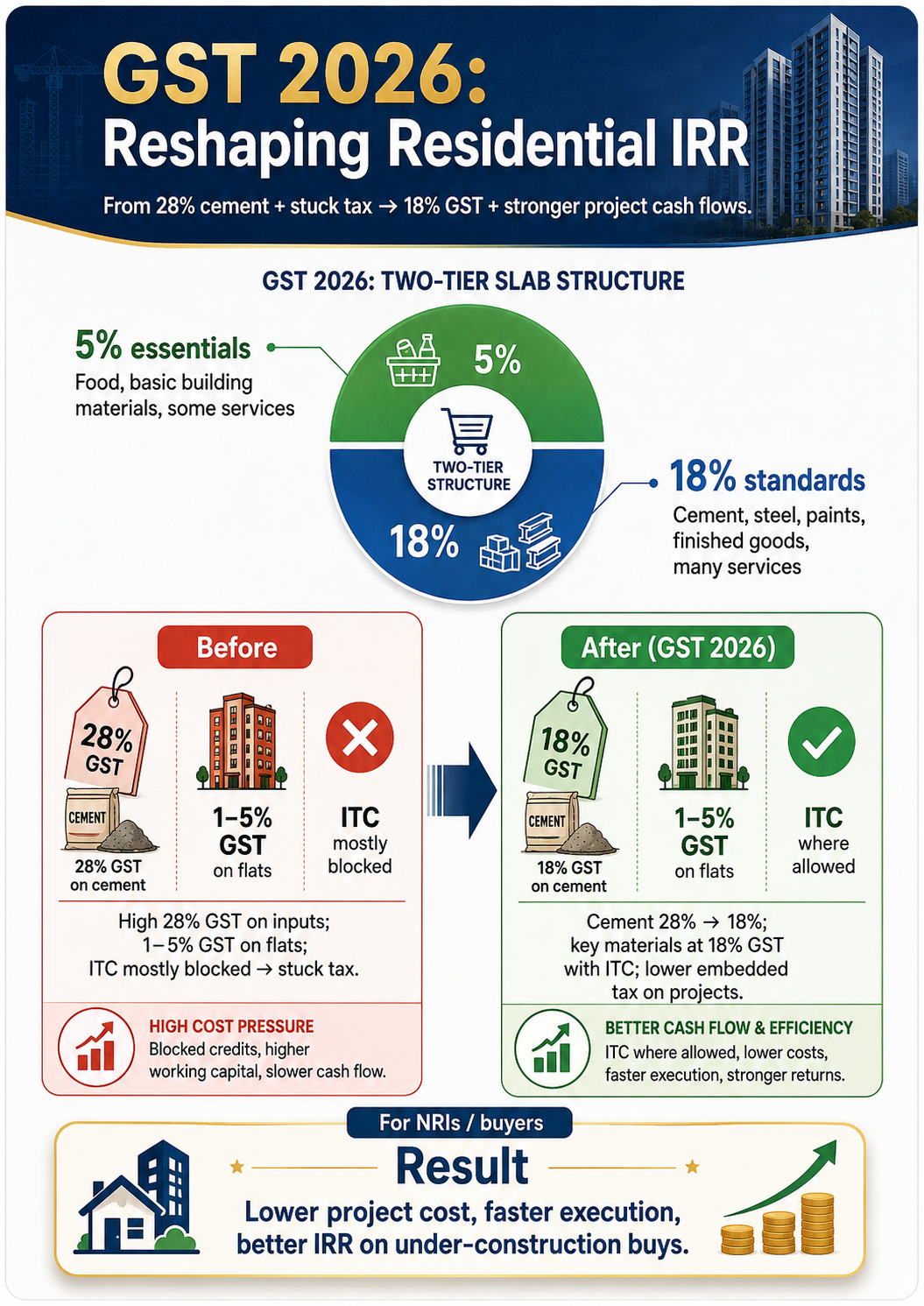
Input Tax Credit Simplification
GST 2026 fixes the biggest headache: Builders pay high GST on cement (28%) but charge low GST on flats (1-5%). Earlier, they lost this difference as "stuck tax."
Now: Full tax credit flows, so cement drops to 18%. Builders save 2-3% on every flat and pass it to buyers. Projects finish 20-30% faster.
Result: Cheaper under-construction homes ITC benefits GST 2.0 (effective 1-5% GST).
Property Completion Exemptions
Ready flats = ZERO GST once builders get a completion certificate. Sell anytime, no GST tax.
Rentals stay simple: Live-in residential renting under ₹20 lakh/year = GST-free (4-6% rental income safe). Perfect for residential rental GST exemption rules NRIs.

Acquisition Cost Reductions
GST 2026 drives down entry barriers through material cost cuts, analysed here for strategic buying in stabilised markets like Bengaluru.
Developer Savings Passed On
Builders save 2 to 4% on cement, steel, paints (instead of 28% GST it's just 18%). They pass this as a launch discount on affordable flats GST 5% slab Bengaluru under ₹45 lakh.
Real Savings: ₹2 to 5 lakh off per flat in suburbs, first-time buyers and NRIs get the best deals.
Why do first-time buyers and NRIs get the best deals?
High competition forces builders to share GST 2026 residential investment returns India benefits.
Bengaluru Market Stabilization
Post GST 2026 suburbs such as Mumbai, Delhi, and Bengaluru stabilises 3 to 5%. Perfect timing for NRI - easy money transfer, 8 to 10% growth ahead.
Rental Income Optimisation
Learn tactics to structure rentals for GST exemptions, maximising net cash flows in the GST 2026 era.
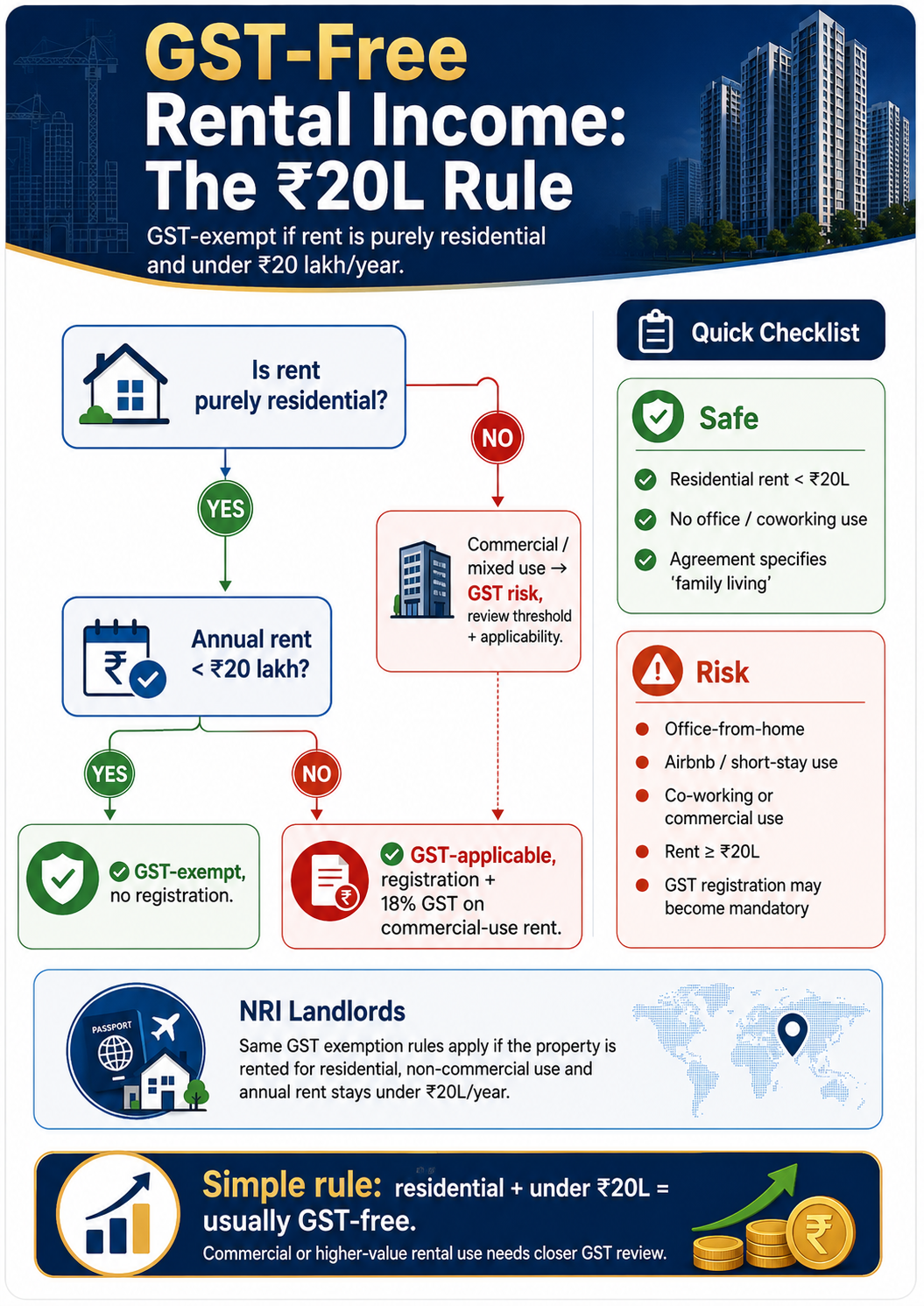
Exemption GST Strategies
Keep rentals "personal use" = no GST if under ₹20 lakh/year. Gets you 4-6% rental income safely.
Don't mix: No office-from-home or Airbnb. Write "family living" in the rent agreement.
NRIs: Same rules apply - residential rental GST exemption rules NRIs = full rental profits.
Indiassetz Yield Benchmarks
Bengaluru gets 5.5% rental yield on completed flats (no GST). Better than before GST 2026.
NRIs: Use Power of Attorney to manage.
High-Return Investment Tactics
Targeted plays leveraging GST 2026 for 8-12% returns, blending capital growth and income.
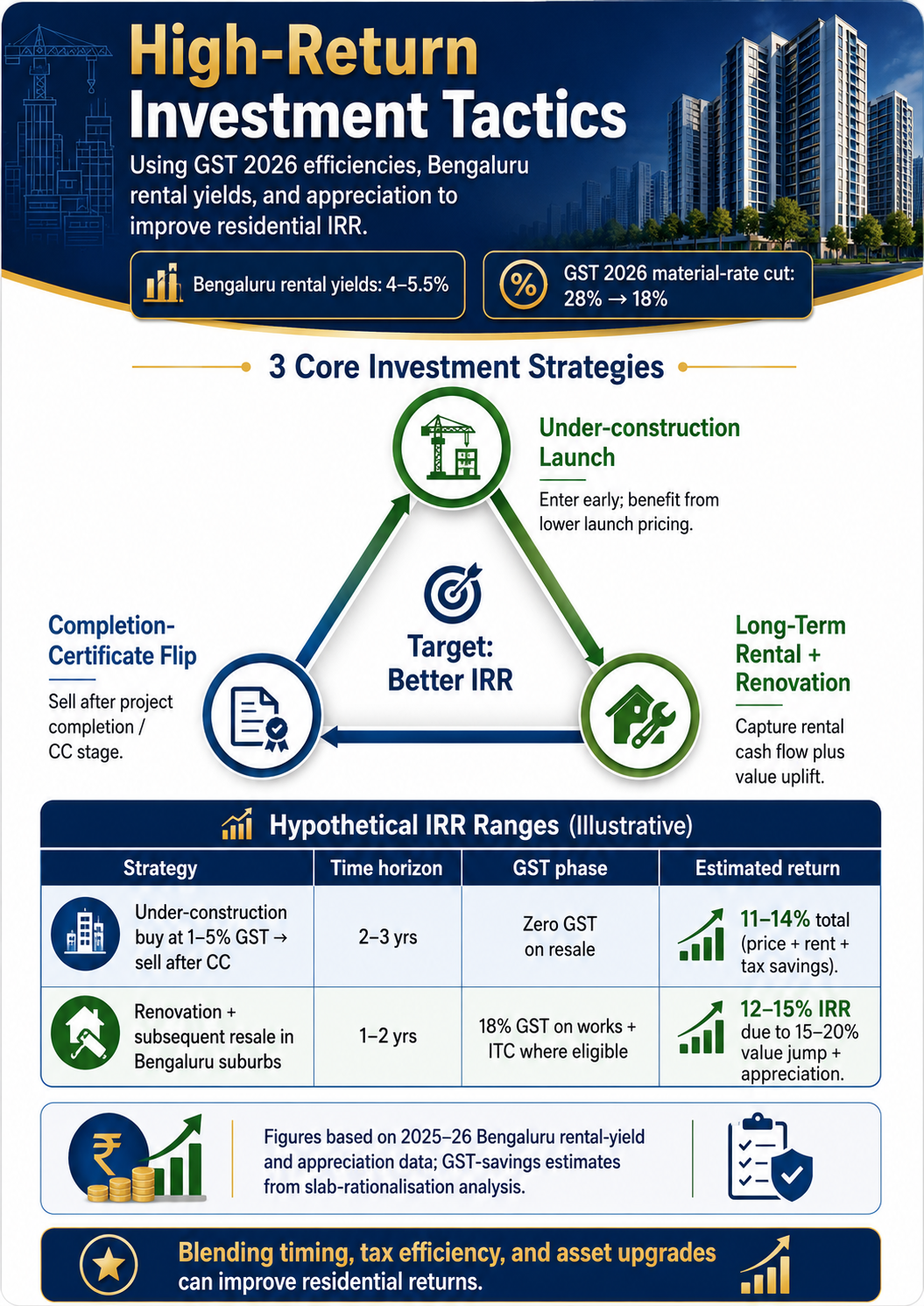
Under-Construction Focus
Buy new flats at launch (1-5% GST only). Wait 2-3 years = 7-9% price jump + 4% rent.
Perfect timing: Enter now, sell after completion certificate (zero GST). 11-14% total returns.
Renovation and Suburb Plays
Spend on upgrades = Claim 18% GST back + 15-20% value jump. Add Bengaluru suburbs property appreciation GST savings (8%/year).
So, in total 12.5% returns whether you sell fast or hold for rent.

Conclusion – Imaging Your GST 2026 Portfolio
As a NRI you've bought suburb flats around Bengaluru / Mumbai / Chennai / Delhi / Hyderabad at 2-4% GST discount, rented GST-free at 5.5% yield, appreciating 8-10% yearly – all remotely managed while you focus on life abroad. GST 2026 made this possible by slashing costs and complexity.
We've walked the path from black money chaos to two-tier simplicity. Affordable under-construction + compliant rentals = 11-14% returns in reach. But execution matters.
What if you had a partner who:
Spots deals others miss (₹2B+ AUM track record)
Manages remotely (maintenance, tenants, legal – zero hassle)
Optimises taxes (GST + income tax + repatriation)
Indiassetz Infra Services Private Limited built exactly this for 10K+ NRIs/HNIs. Founded by ex-bankers, our tech + experts deliver family-office-grade real estate wealth management – from discovery to dividends.
Curious how GST 2026 fits YOUR goals?
Drop a note at Contact Us. Let's innovate your property portfolio together, the GST 2026 residential investment returns India era waits for no one.
FAQ for GST 2026 Residential Returns
1. What is ITC in GST?
ITC stands for Input Tax Credit, a term under GST that helps businesses avoid double-paying taxes.
For example, imagine you run a shop. You buy goods from a supplier and pay GST on them, say ₹10. Then you sell those goods to customers and charge them GST, say ₹15. Without ITC, you would pay the full ₹15 to the government, even though you already paid ₹10 earlier.
ITC lets you subtract that ₹10 from the ₹15, so you only pay ₹5, which is the tax on the extra value you added by selling. It works like getting credit for taxes you have already paid.
2. What is GST 2026 for residential real estate in India?
GST 2026 introduces a simplified two-tier regime with 5% for essentials and 18% as the standard rate, along with ITC reforms for developers and exemptions on completed properties.
This can reduce input-cost leakage on cement, steel, and construction, lowering the effective GST on under-construction flats to 1–5% and making GST on completed flats 0%.
3. Is GST applicable on ready-to-move flats in 2026?
No, ready-to-move flats with a completion certificate are treated as the sale of immovable property and are outside GST, which means 0% GST.
This applies whether the buyer is a resident or an NRI.
4. How does GST 2026 affect NRI real estate investors?
NRIs may benefit from lower GST-inclusive prices on under-construction homes due to 1–5% effective GST and possible ITC pass-through.
They may also benefit from GST-free residential rental income if the property is rented for family or home use and annual rental income is under ₹20 lakh.
5. How does GST 2026 impact rental income from residential property?
Purely residential rental income under ₹20 lakh annually is exempt from GST and treated as personal use.
Commercial or mixed-use rental activity, such as Airbnb or office-from-home usage, may attract GST at 18% and require separate compliance.
6. Does GST apply to renovating or upgrading an existing flat?
If renovation is done through a registered contractor, GST at 18% applies to the services. Developers or builders may be able to claim ITC on eligible works.
Smart upgrades can increase valuations by 15–20% and, when combined with GST-driven savings, may help generate 12%+ total returns if held or sold strategically.
7. What are the best high-return investment tactics under GST 2026?
Key strategies include buying under-construction flats at launch with 1–5% effective GST and selling after completion when GST becomes 0%, potentially supporting 11–14% total returns.
Another strategy is focusing on fast-growing suburbs with 8–10% appreciation and 5–6% rental yield, especially in Bengaluru, Mumbai, and Delhi-NCR.
8. How can first-time buyers and NRIs get the best GST 2026 deals?
Builders may pass 2–4% savings on cement, steel, and paints as launch-time discounts, especially in affordable segments under ₹45 lakh.
High competition in suburbs such as Bengaluru’s emerging corridors can push developers to offer deeper discounts and early-bird benefits to NRIs and first-time buyers.
9. How does GST 2026 affect Bengaluru’s residential market?
GST 2026 can reduce developer input costs on construction materials, helping stabilise prices in suburbs by 3–5%.
Combined with 8–10% expected appreciation and 5.5% rental yields on completed flats, this may create a favourable environment for both NRI and local investors.