The Rise of Integrated Townships in the Peripheral Zones of Mumbai and Chennai
Table of Contents
- Introduction
- What are Integrated Townships?
- Why Peripheral Zones are Gaining Importance?
- Mumbai: Township Growth Beyond the Core City
- Chennai: Expansion Through Corridors and Planned Growth
- Why Integrated Townships Appeal to Modern Buyers?
- Standalone Apartment vs Integrated Township
- Investment Outlook: Why Investors are Watching These Zones
- Key Checks Before Buying in an Integrated Township
- How Indiassetz Helps Buyers and Investors?
- Conclusion: The Future of Modern Living is Moving Outward
Introduction
Integrated townships are becoming one of the strongest real estate trends in India’s major metropolitan regions. As Mumbai and Chennai expand beyond their traditional city cores, homebuyers and investors are increasingly looking at peripheral zones that offer better space, improving infrastructure, gated community living, and modern lifestyle amenities.
For Indiassetz Infra Service Pvt Ltd, this shift reflects a larger change in real estate wealth creation: buyers are no longer purchasing only a home; they are investing in a complete ecosystem.
India’s real estate sector is projected to grow to Rs 88 Lakh Crore by 2030, driven by urbanisation, infrastructure expansion, and rising housing demand. This makes integrated townships in Mumbai and Chennai’s peripheral zones an important opportunity for both end-users and long-term investors.
Financial advisor insight: “The best real estate investments are not always in the city centre. They are often in locations where infrastructure, employment, and lifestyle demand are all moving together.”
What are Integrated Townships?
Integrated townships are large, planned developments that combine residential spaces with lifestyle, social, and sometimes commercial infrastructure. Unlike standalone apartments, these communities are designed to support daily life within one ecosystem.
They usually include:
Gated community security
Clubhouse and wellness amenities
Schools, retail, healthcare, and open spaces
Internal roads and planned infrastructure
Green zones, walking tracks, and recreation areas
Better long-term asset management
This is why integrated townships are closely linked with modern living. They offer convenience, safety, lifestyle, and community, all within a planned environment.

Why Peripheral Zones are Gaining Importance?
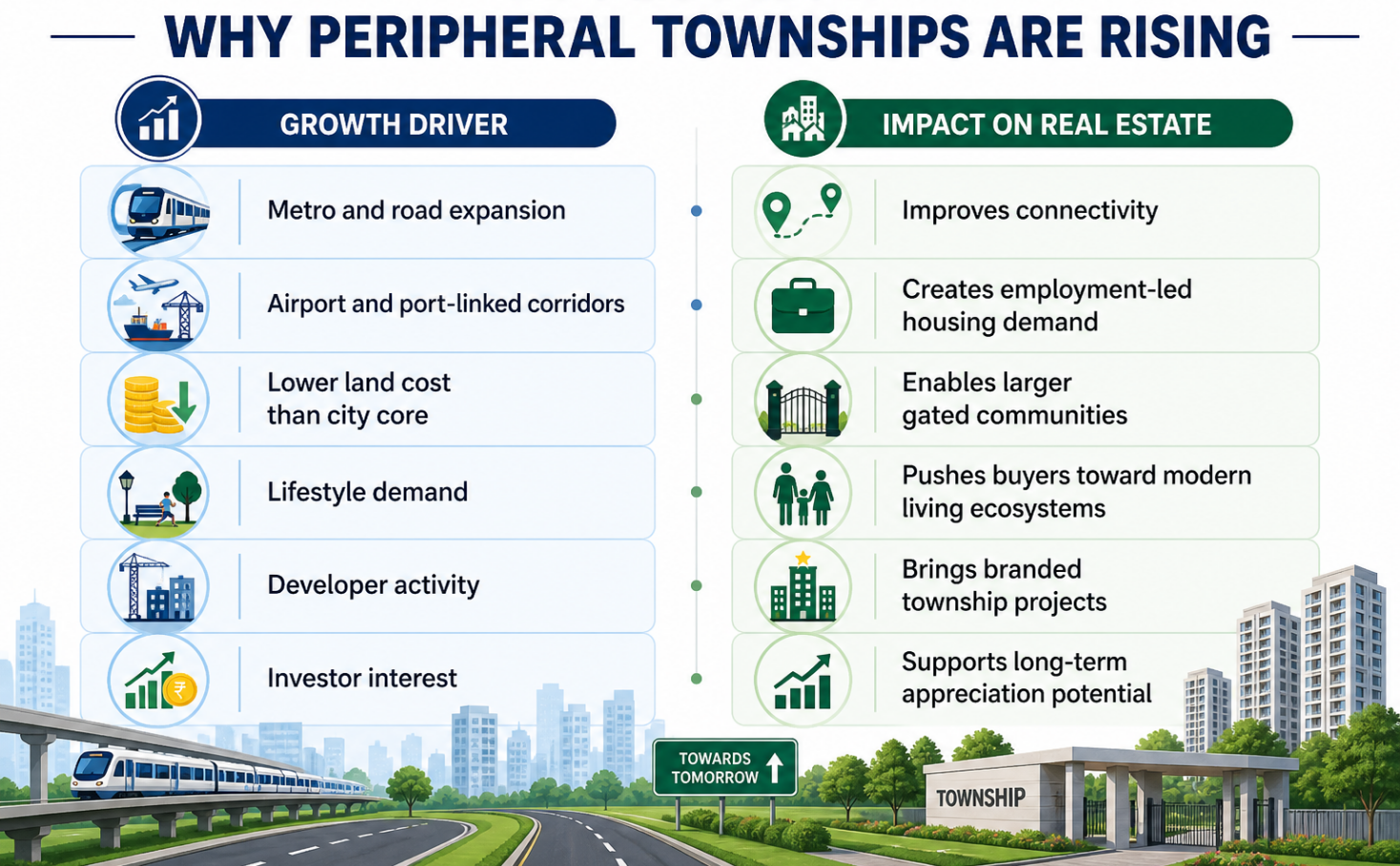
Both Mumbai and Chennai face similar urban challenges: limited land in the city core, rising prices, traffic congestion, and increasing demand for better quality of life. Peripheral zones offer a solution by providing larger land parcels, more planned layouts, and relatively better affordability.
Recent research documents also identified infrastructure, government policy, peripheral growth corridors, and market analytics as major drivers of township growth in Mumbai and Chennai.
Mumbai: Township Growth Beyond the Core City
Mumbai’s real estate growth is increasingly shifting toward the wider Mumbai Metropolitan Region. Areas such as Navi Mumbai, Panvel, Ulwe, Kharghar, Taloja, Thane, Kalyan-Dombivali, Bhiwandi, Vasai-Virar, and NAINA are gaining attention because they combine improving infrastructure with relatively better space availability.
A key infrastructure catalyst is the Atal Setu / Mumbai Trans Harbour Link, which opened for public use on 13 January 2024 and has improved regional mobility between Mumbai and Navi Mumbai. This has strengthened the investment case for peripheral locations connected to Navi Mumbai, Panvel, and future growth corridors.
According to Economic Times, a recent report also noted that buyer activity in Mumbai is gravitating toward peripheral locations as affordability pressures persist in core markets.
Financial advisor insight: “In Mumbai, the opportunity is not just about lower entry price. It is about entering infrastructure-backed corridors before they become fully priced.”

Chennai: Expansion Through Corridors and Planned Growth
Chennai’s peripheral growth is being shaped by corridors such as OMR, GST Road, Oragadam, Sriperumbudur, Chengalpattu, Mahabalipuram, and the upcoming Parandur airport influence region. These areas are supported by IT, manufacturing, logistics, automobile, and industrial activity.
The Chennai Metropolitan Area is also being shaped by long-term master planning. CMDA’s third master plan is expected to guide Chennai’s development for 2027–2046, focusing on areas such as accessibility, mobility, safety, climate resilience, and access to land and housing.
This makes Chennai’s peripheral zones attractive for integrated townships because the city’s growth is no longer limited to traditional residential pockets. Homebuyers are looking for planned communities near work hubs, schools, highways, and future infrastructure.

Why Integrated Townships Appeal to Modern Buyers?
The modern homebuyer wants more than square footage. They want security, lifestyle, wellness, convenience, and long-term liveability. Integrated townships meet this demand by offering a self-sufficient residential environment.
For families, they offer safer internal roads, play areas, schools nearby, and community spaces. For working professionals, they offer better amenities, work-from-home comfort, and access to business corridors. For NRIs and HNIs, they offer managed living and better asset visibility.
This is also where gated community living becomes important. A gated community inside a township gives buyers controlled access, better maintenance, shared amenities, and a stronger sense of community.
Standalone Apartment vs Integrated Township
| Feature | Standalone Apartment | Integrated Township |
|---|---|---|
| Security | Basic to moderate | Gated, controlled access |
| Amenities | Limited | Clubhouse, sports, wellness, retail |
| Open spaces | Often limited | Planned green zones |
| Daily convenience | Outside dependency | Many services within or nearby |
| Investment appeal | Location dependent | Location + ecosystem driven |
| Community living | Smaller scale | Larger, organised community |
Investment Outlook: Why Investors are Watching These Zones
Integrated townships in peripheral zones can offer three major investment benefits: lower entry cost compared to core areas, future appreciation through infrastructure, and stronger rental appeal once employment hubs mature.
In Mumbai, peripheral growth is supported by bridges, metro expansion, road networks, and Navi Mumbai-led development. In Chennai, growth is supported by IT corridors, industrial belts, automobile hubs, and long-term metropolitan planning.
India’s real estate sector is also expected to expand to US$5.8 trillion by 2047, contributing 15.5% to GDP, according to IBEF. This long-term growth outlook supports the case for planned urban communities in expanding metro regions.
Financial advisor insight: “A township investment should be evaluated like a long-term wealth asset, not only by today’s price, but by future connectivity, tenant demand, and exit potential.”

Key Checks Before Buying in an Integrated Township
While the opportunity is strong, buyers must be careful. Every township is not automatically a good investment. The right due diligence should include:
Developer track record
RERA registration
Title clarity and approvals
Actual infrastructure progress
Maintenance charges
Construction quality
Rental demand in the micro-market
Distance from employment hubs
Future supply in the same corridor

How Indiassetz Helps Buyers and Investors?
Indiassetz Infra Service Pvt Ltd positions itself as a real estate wealth-tech company that advises, manages, and executes real estate requirements for customers. Its services include advisory, buy/sell/rent, rental renewal, property management, legal assistance, valuation, and more.
For integrated township investments in Mumbai and Chennai, Indiassetz can support buyers with:
Location and corridor analysis
Property discovery
Developer and project evaluation
Legal and valuation checks
Transaction support
Rental and property management
Long-term portfolio advisory
Indiassetz also states that it manages real estate wealth with precision and strategic insights, similar to how trusted banks manage cash assets.
Conclusion: The Future of Modern Living is Moving Outward
The rise of integrated townships in the peripheral zones of Mumbai and Chennai is not just a real estate trend. It is a response to how Indian cities are changing. As infrastructure expands and homebuyers seek better lifestyles, peripheral zones are becoming the new centres of growth.
For buyers, these townships offer gated community living, modern amenities, open spaces, and convenience. For investors, they offer the potential for long-term appreciation, rental demand, and portfolio diversification.
In the next decade, the most valuable real estate opportunities may not only be found in the heart of Mumbai or Chennai, but in the well-connected, well-planned communities rising around them.