

The Role of the National Single Window System (NSWS) in Streamlining Property Approvals
For years, a greenfield property in India did not stall only because of land or capital. It stalled in the gaps between departments. A developer could clear title, lock finance, and still lose months chasing building-plan sanction, fire NOC, environmental consent, utility connections, and labour registrations across separate portals, offices, and file numbers. That friction is expensive. Industry accounts still point to pre-construction delays stretching beyond a year in several markets, and developers have reported average approval slippages of around six months in recent cycles. The cost shows up as higher holding charges, longer interest carry, delayed launches, and thinner margins. National reforms have begun to close that gap. India’s rank on the World Bank’s “Dealing with Construction Permits” indicator rose from 181 in 2017 to 27 in the 2020 assessment, with the measured process reduced to 15 procedures and about 106 days in the cities tracked.
Recent research found that large residential projects of 500-plus units in the top seven cities now take about 4.9 years on average, against 6.1 years in the previous decade. The unfinished work is the part that still decides whether a plot becomes a project on time. That is why the National Single Window System (NSWS), launched on 22 September 2021 by DPIIT and Invest India, matters for real estate and not only for factories. It is the Centre’s attempt to replace a scatter of ministry and state gateways with one digital front door for identifying, applying, and tracking clearances.
Official figures tell the scale: as of 20 November 2025, 11,75,435 approvals had been applied for through NSWS and 8,29,750 had been granted, across 32 Central ministries and 34 States. More than 1.3 lakh users have already used the Know Your Approvals (KYA) tool to generate a project-specific checklist before they file. Site selection is being pulled into the same ecosystem through the India Industrial Land Bank, which maps over 4,200 parks across more than 6.5 lakh hectares, with over 1 lakh hectares recorded as available. NSWS does not erase every local building or pollution clearance. What it does is make the approval map visible early, cut repeat paperwork, and connect Central and State Single Window Clearance Systems so a greenfield developer can see the full sequence before capital is committed. The sections that follow set out how that architecture works, and the land and building checklists that still determine whether a project moves from plot to ground-breaking.
What are National Single Window Systems (NSWS) helpful for real Estate?
The National Single Window System (NSWS) is a transformative digital advisory platform launched by the Government of India under the leadership of the Department for Promotion of Industry and Internal Trade (DPIIT) and Invest India. Serving as a centralized "one-stop shop" for investors and businesses, the system simplifies complex regulatory approval processes and reduces administrative friction across central and state authorities.
NSWS, as one part, and state-level Single Window Clearance Systems (SWCS), as another repository, play a transformative role in streamlining property, construction, and real estate approvals in India. Together, these platforms integrate and unify the end-to-end clearance ecosystem, addressing historical delays caused by fragmented, multi-portal regulatory approvals across various central ministries and state authorities.
What are the Key Features of NSWS and SWCS for Developers and Property Owners?
NSWS and State Single Window Clearance Systems do not replace every statutory clearance. They change how a developer finds, files, and tracks those clearances. For property owners and greenfield promoters, the practical gain is a single digital path instead of a chain of disconnected portals. Registration is free, PAN is the primary business identity, and the Know Your Approvals module turns project details into a tailored checklist before an application is filed. Land discovery, document reuse, query handling, and live status tracking sit on the same framework, so the sections below focus on the features that actually move a plot from intent to approval.
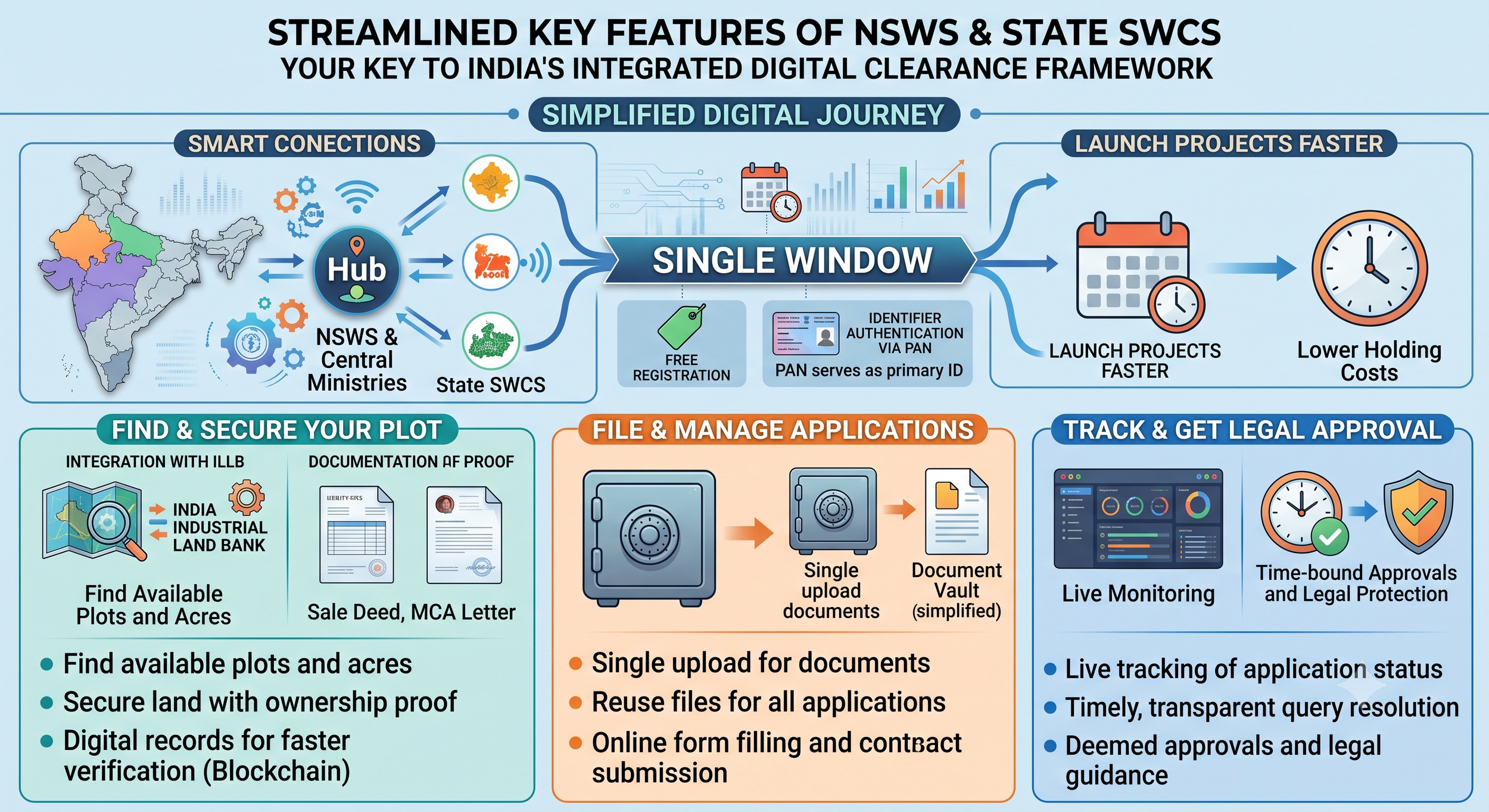
NSWS Framework
Digital Infrastructure and Framework
Federated Connectivity: Operating as a unified portal, the NSWS acts as an intelligent bridge that links and tracks various regulatory permissions between central ministries and regional State Single Window Clearance Systems (SWCS). By leveraging advanced Application Programming Interfaces (APIs), the platform ensures seamless data exchange with state portals such as (Person A) in Rajasthan, (Person B) in Uttar Pradesh, and (Person C) Invest in Madhya Pradesh. This digital architecture is built on a 12-week standardised timeline to accelerate project launches and lower holding costs.
No Cost for Registration: Joining this advanced digital ecosystem is completely free of charge, ensuring that onboarding remains accessible for all business users.
Identifier Authentication via PAN: In alignment with national policies, the Permanent Account Number (PAN) serves as the primary business ID. Developers must complete a verification process using Digital Signature Certificates (DSC) or by syncing credentials directly from their DigiLocker accounts.
Guided Compliance through KYA: The Know Your Approvals (KYA) module uses an interactive questionnaire to evaluate project specifics—such as location and investment volume—to produce a tailored regulatory roadmap. This eliminates initial uncertainty by providing a precise checklist of necessary approvals prior to the application stage.
Identifying Land and Validating Property Titles
Integration with IILB: To facilitate easier site selection, the NSWS connects with the India Industrial Land Bank (IILB), offering high visibility into available plots. Developers can view real-time data on numerous acres of industrial, commercial, and residential land ready for immediate use. In regions like Jammu & Kashmir, this connectivity allows for direct application for plots within 45 specialised industrial parks.
Documentation for Ownership Proof: For privately owned sites, developers are required to provide a registered sale deed and a recent utility bill. If the project is located within a government-backed zone or incubation centre, an official allotment or approval letter is necessary. Furthermore, the platform requires a Name Approval Letter from the MCA’s RUN service to be secured before final processing.
Modernizing Records with Blockchain: Regional SWCS portals are increasingly utilising ledger technology to prevent fraud and speed up verification. Andhra Pradesh’s "Bhoomi" system, developed with ChromaWay, provides a decentralised platform for secure land record management. Similarly, Maharashtra is testing public ledger projects with financial institutions to authenticate digital deeds for investors and lenders.
Remote Property Registration Services: Tamil Nadu has introduced a "presence-less" system, enabling developers to finalise property registrations through secure digital channels, bypassing the need for physical visits to registrar offices or waiting for appointment slots.
Managing Queries and Essential Documents
Centralised Document Vault: The system allows for a one-time upload of critical files—such as identity proofs and land deeds—which can then be utilised across multiple applications, significantly reducing redundant administrative tasks.
Unified Query Resolution: Any clarifications or objections raised by government departments are funnelled into a single interface. This allows developers to provide digital responses and documentation, removing the necessity for physical visits to municipal departments.
Live Application Monitoring: A comprehensive dashboard offers real-time insights into application progress, assigned officials, and adherence to statutory Service Level Agreements (SLAs).
Legal Protections and Compliance Support
Provisions for Deemed Approval: In states like Telangana, Karnataka, and Gujarat, approvals are subject to strict timelines. If a department does not respond within the fixed window—usually 15 to 30 days depending on project size—the clearance is automatically granted by law to prevent project stagnation.
Legal Liability Assistance: The Raj Nivesh platform in Rajasthan includes a specialised wizard that helps users understand specific legal sections and potential penalties, promoting proactive compliance and risk management.
Housing for the Workforce: New initiatives on state portals are integrating workforce housing approvals directly into the clearance workflow. In Gujarat, for instance, developers can coordinate the setup of hostels and dormitories through various models, such as PPPs or industrial associations, alongside their main project approvals.
What are the Challenges Addressed by NSWS for Properties?
Fragmented, multi-portal regulatory approvals that historically caused delays and administrative friction are unified into a centralised, efficient one-stop shop.
The historical complexity of dealing with numerous central ministries and state authorities independently is eliminated through a single, seamless digital interface.
Lack of transparency and real-time visibility into application status is replaced by a comprehensive dashboard that tracks progress, assigned officials, and service level adherence.
Uncertainty during the pre-application phase is reduced by guided compliance tools that generate tailored regulatory roadmaps, eliminating initial confusion about necessary documentation.
The administrative burden of repetitive data entry is significantly decreased through centralised document vaults, which allow for the one-time upload of critical files for reuse across multiple applications.
Physical reliance on municipal departments is minimised, as clarifications and objections are now funnelled into a single interface for digital response and documentation.
Stagnation caused by department delays is prevented through strict Service Level Agreements (SLAs) and legal provisions for "deemed approval" in several states, where clearances are granted automatically after a fixed window.
Compliance risks are mitigated through specialised tools and wizards that provide clarity on legal sections and potential penalties, supporting proactive risk management.
The difficulty of coordinating complex infrastructure needs—such as workforce housing—is simplified by integrating these requirements directly into the core clearance workflow.
Conclusion
The National Single Window System (NSWS) and State Single Window Clearance Systems (SWCS) are changing how property approvals are managed in India. By bringing approvals, documentation, tracking, and compliance requirements into a connected digital ecosystem, they reduce regulatory friction and give developers greater clarity and certainty. For greenfield developments, understanding the approval ecosystem before investing is no longer optional, it is critical to making a commercially sound property decision.
At Indiassetz, we go beyond simply identifying properties. We help investors and developers understand the location, regulatory environment, development potential, and investment implications before they commit capital. If you are evaluating a property or planning a development, speak to Indiassetz to get the insights you need to make a smarter, better-informed real estate decision.